What Is Engineering? A Simple and Exciting Way to Look at It
Engineering is the art of arranging what nature already does: choosing properties and setting conditions within a budget of energy, resources and time. One idea, from a dog on a railway track to a cooling cup of chai.
 Sharath Jonnala
On this page
- A dog, a train, and a split second
- How engineering really works: nature acts, engineers arrange
- Your brain plays by the same rules
- Why this view changes how you engineer
- Properties, laws and principles: the difference in one minute
- What each branch of engineering boils down to
- Why your first instinct about trends is often wrong
- Light a bulb: more current is not more power
- Watch the rain: a ceiling that falls from the sky
- Count the caffeine: why the evening chai is still with you at midnight
- Drive across town: slower is not always cheaper
- Sing to a glass: timing beats strength
- Where instinct breaks, branch by branch
- Frequently asked questions
- What is engineering in simple words?
- What does an engineer actually do?
- What is the difference between science and engineering?
- What is the difference between engineering and technology?
- What are the main branches of engineering?
- How do I choose an engineering branch?
- What is the difference between a law and a principle in physics?
- Is engineering hard?
- Why is engineering important?
- The world is already capable
A dog, a train, and a split second
A dog wanders onto a railway track. A train is coming. A stranger on the platform jumps down, grabs the dog, and rolls clear with a second to spare.
The crowd claps. The video spreads. By evening the headlines carry one word: hero.
Now look closer. That stranger has a family. A child who needs a parent. A partner. Parents who depend on them. In half a second, a secure future was wagered on a chance. Had the timing been off by one second, the same headline would read "tragedy", and some would quietly say "reckless".
Same person. Same act. A different label, depending on which variables you choose to look at.
So what really happened on that track? And why does the human mind tend to read it in only one way? It was neither magic nor fate. A set of variables met a set of conditions, bounded by finite energy and resources and by time, and interacted to produce an outcome: fundamentally, a decision.
Hold on to that sentence. It is also the most honest definition of engineering, and of almost any system, there is.
How engineering really works: nature acts, engineers arrange
Long before the first engineer, the world was already at work.
Fire was hot.
Stone was strong.
Copper carried current with almost no resistance.
Water swelled as it froze.
Light bent as it slipped from air into glass.
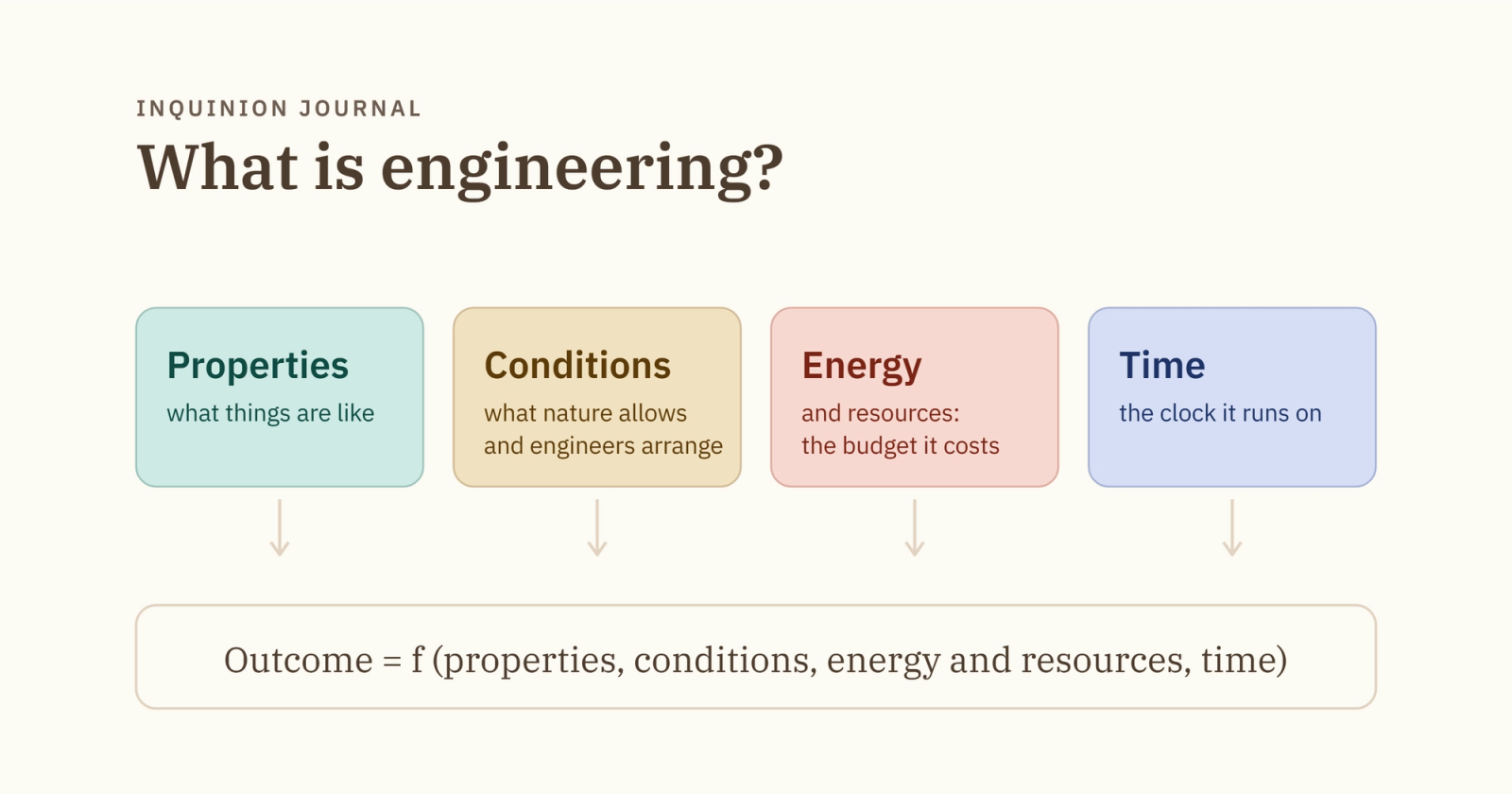
Each of these is a property: a fixed way something behaves under given conditions.
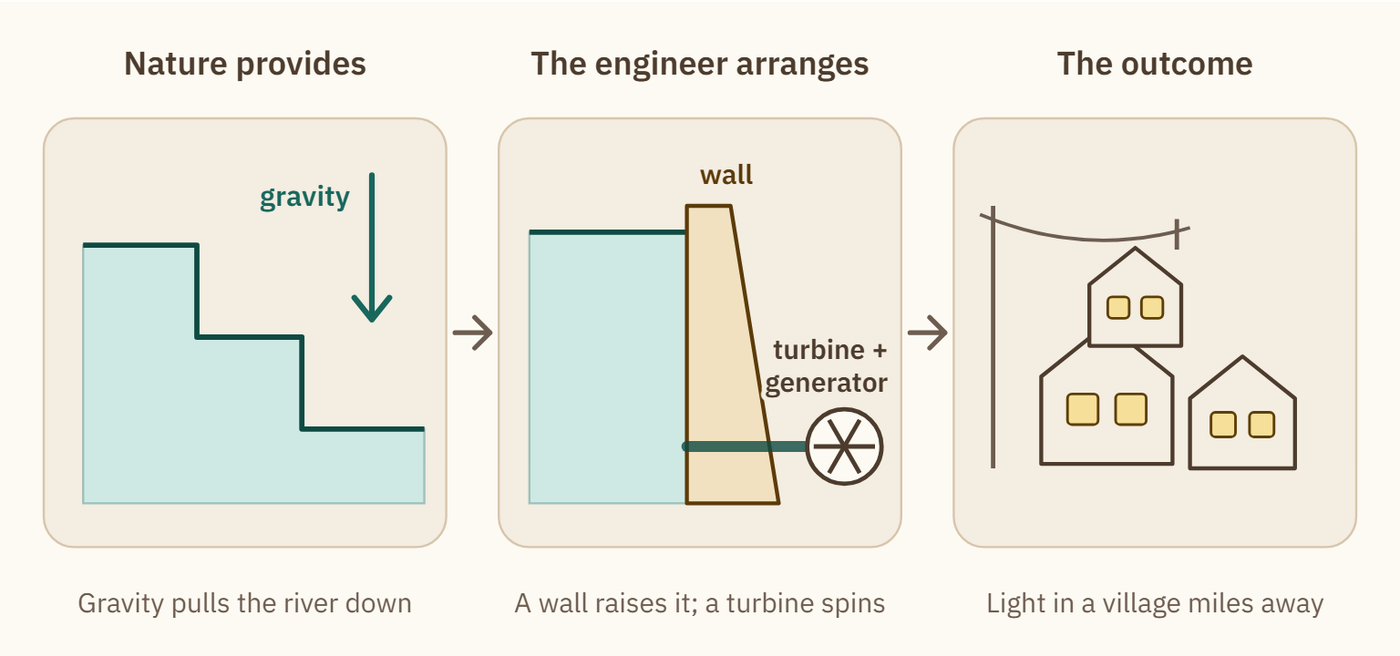
Then, one day, someone stood beside a river and watched it fall. Gravity was already pulling the water down. They built a wall, raised the water high, and set a turbine in its path to spin a generator.
The fall became light in a village miles away.
Less than a century later, someone etched tiny switches into silicon. The switches flipped, billions of times a second.
They became the phone in your hand.
That is engineering: the quiet art of arranging conditions so the world does what it was already capable of doing.
The art of directing the great sources of power in nature for the use and convenience of man.
Reduced to a single line:
Outcome = f(properties, conditions, energy and resources, time)
And once you see it this way, it is hard to unsee.
Not just in machines. In people, too.
Your brain plays by the same rules
The brain is not outside this world. It is part of it: roughly 86 billion neurons, Azevedo et al. 2009 (opens in a new tab)doi.orgEqual numbers of neuronal and nonneuronal cells make the human brain an isometrically scaled-up primate brainAbout ten times the 8.2 billion people on Earth. Counted by turning brain tissue into an even soup of cell nuclei, which retired the old '100 billion' figure. firing on chemistry and electricity. Its decisions are outputs too.
Decision = f(x₁, x₂, x₃, …, xₙ)
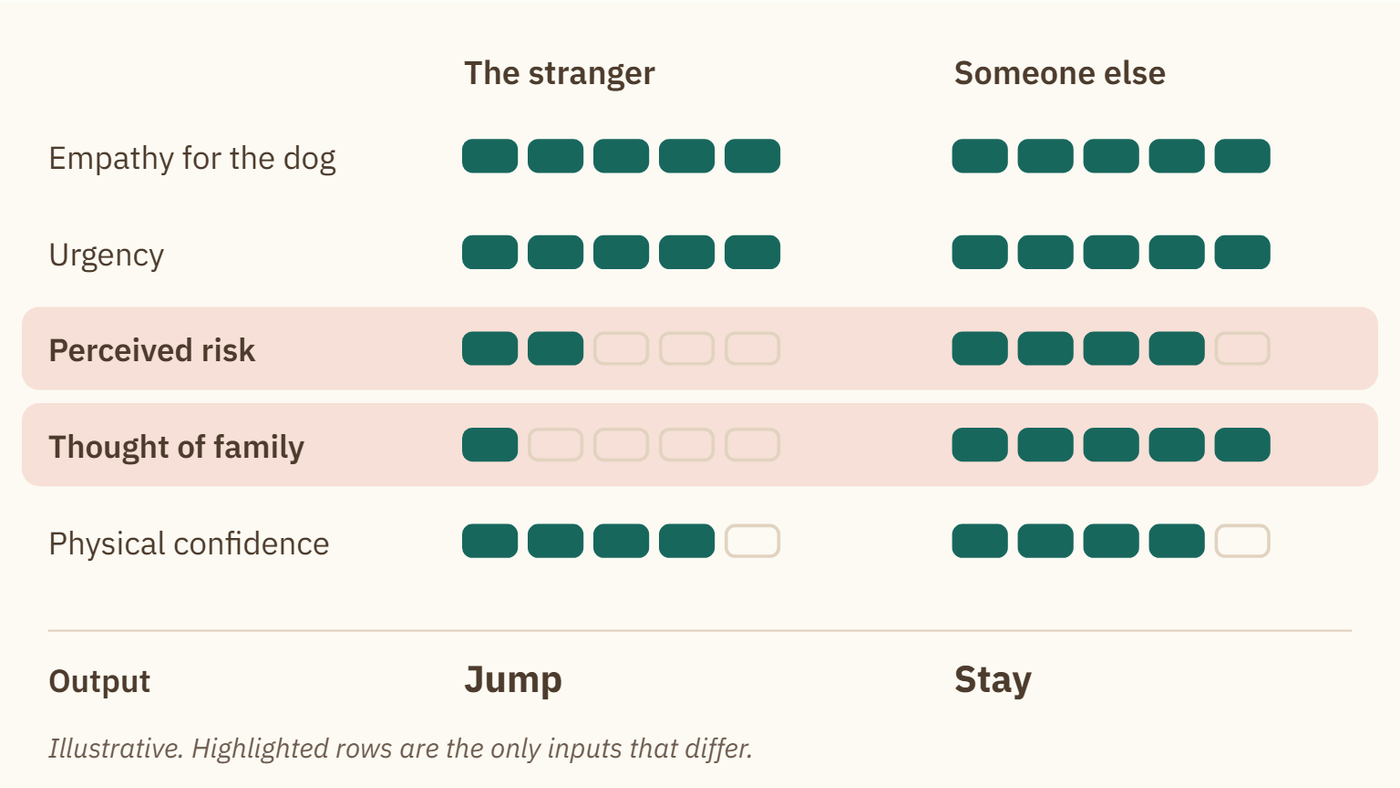
Go back to the platform. The stranger's inputs in that half-second might have been:
- Empathy for the animal: very high
- Urgency, with the train seconds away: very high
- Perceived risk: low, because in a half-second decision attention locks onto the dog, not the train
- Family: barely present in the moment
- Physical confidence: high
The function returned one answer: jump.
A second person on the same platform weighs family higher and judges the risk honestly. They stay still. Not a coward. The same machine, different inputs.
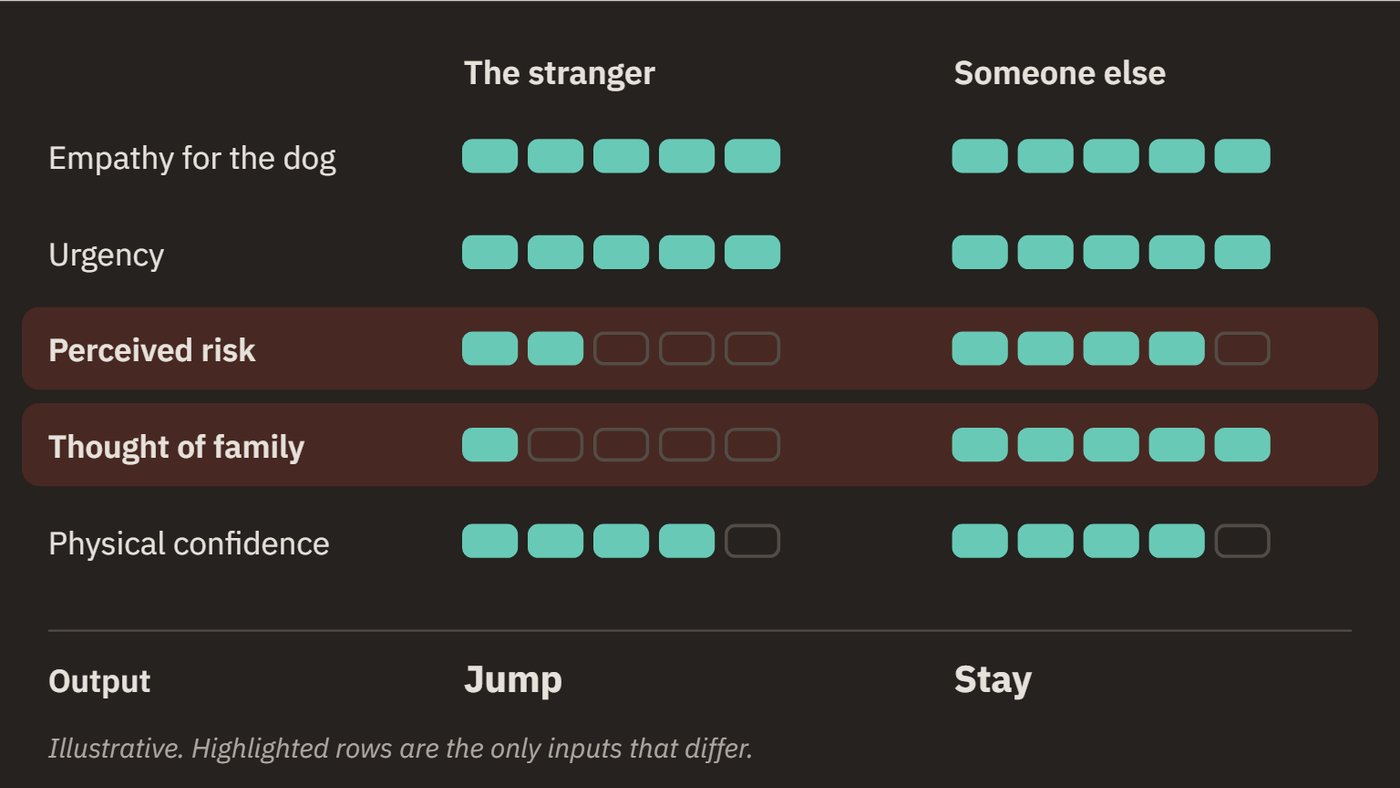
"Hero" is a label we attach to an output. An engineer asks a more exacting question: which inputs, under which conditions, with how much energy and within how much time, produced it?
On that platform, time was the decisive constraint: perhaps two seconds between the train and the dog. Energy was the other: one body, the energy stored in its muscles, no margin for error.
Good engineering widens both margins. A fence along the track keeps the dog off the rails, so no one ever faces a split-second choice. And if someone does end up down there, a recess built beneath the platform edge gives them somewhere to go. The train never needs to stop: one step sideways, dog in arms, and it thunders past. The dog survives, and no one has to gamble their life.
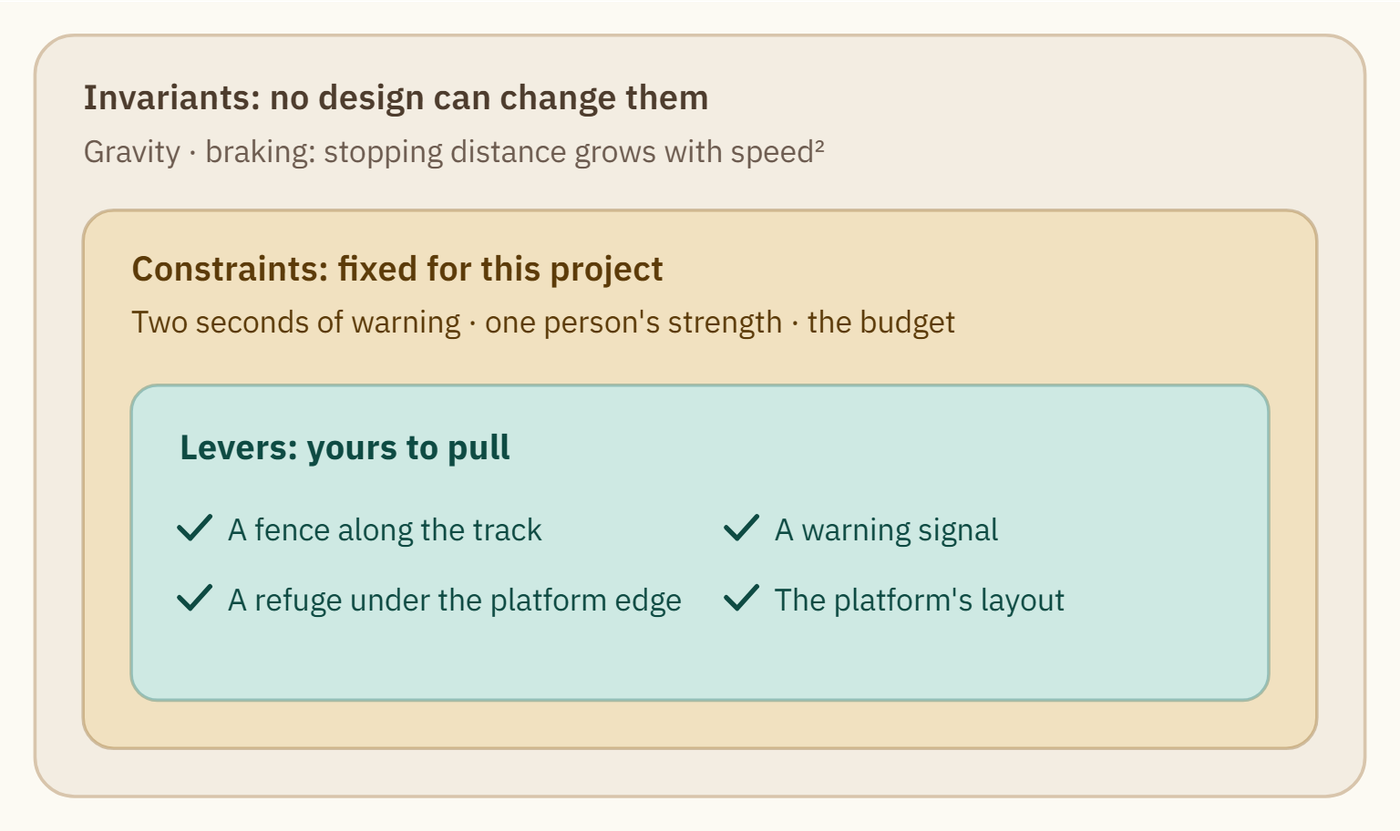
Every engineering problem, then, comes down to one discipline: knowing which levers you can pull.
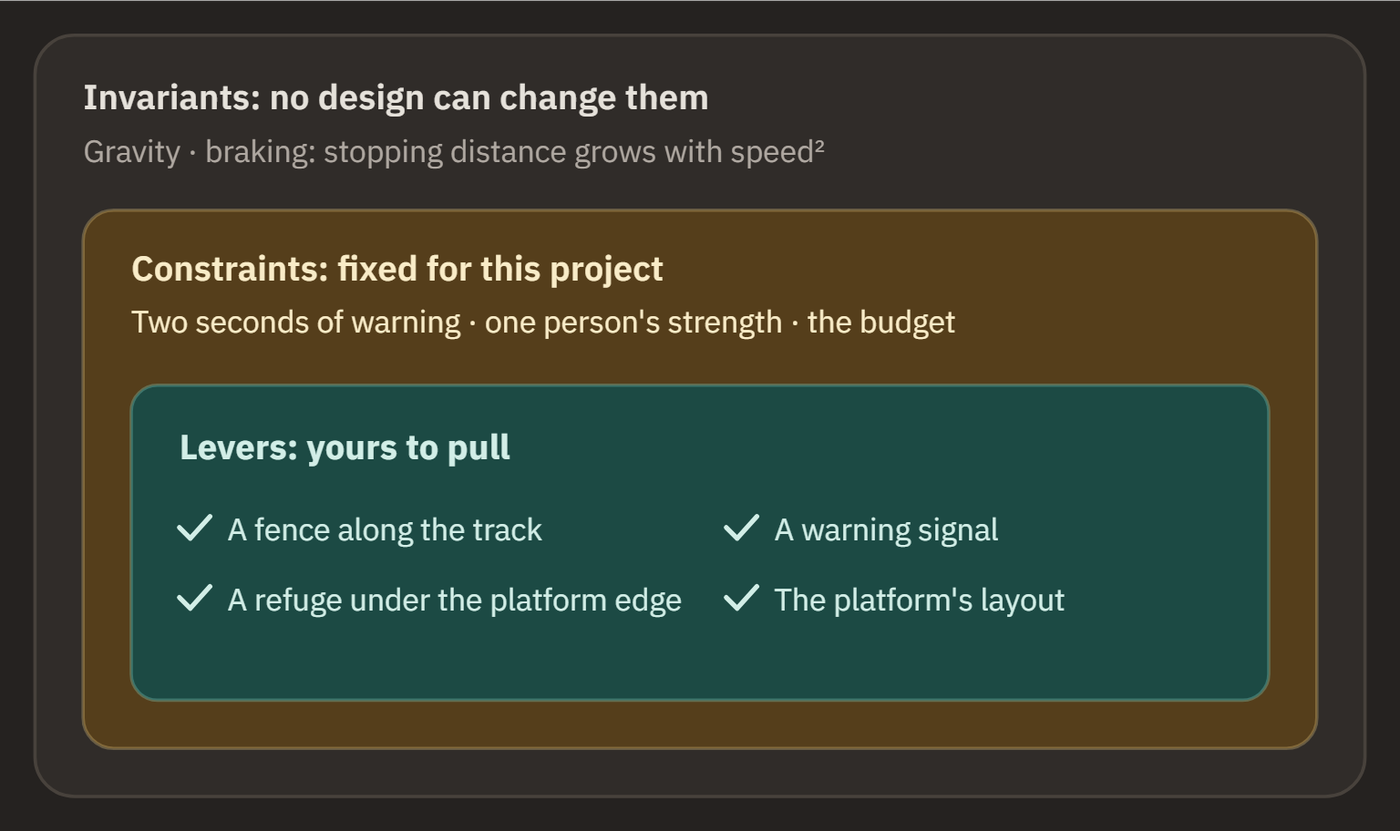
Some quantities are invariants: they hold whatever you do. Others are constraints: fixed for this project, though negotiable in the next. Only a few are genuine levers, the variables you are free to adjust.
| Type | What it means | On the railway platform |
|---|---|---|
| Invariant | A law of nature that no design can change | Gravity; the physics of braking: stopping distance grows with the square of speed |
| Constraint | A limit set by resources or circumstance | Two seconds of warning; one person's strength; the station's budget |
| Lever | A variable you are free to adjust | A fence, a warning signal, a refuge under the platform edge, the platform's layout |
The novice pushes against invariants. The expert accepts them, works within the constraints, and pulls the few levers that matter. That, in a sentence, is engineering, whether you are designing a circuit, a product or an entire system of people and machines.
Why this view changes how you engineer
Remember?
Outcome = f(properties, conditions, energy and resources, time)
Every outcome rests on these four variables. Each has a fundamental nature, and that nature decides how far it can be bent.
Properties are given, but they can be chosen. You cannot argue with the conductivity of copper. You can choose copper over steel, or change what is inside a material, as when steel is heat-treated to rearrange its crystals or silicon is doped with a few atoms of boron or phosphorus, so that it behaves differently.
And every property, however exotic, traces back to a remarkably small core: a few forces and conservation laws, with quantum mechanics deciding how atoms bond and how electrons move through a solid. The rules engineers lean on most:
- Four fundamental forces: gravity, electromagnetism, and the strong and weak nuclear forces. CERN (opens in a new tab)home.cernThe Standard ModelFriction, the stiffness of steel, every chemical bond and the light from a bulb are all electromagnetism. Gravity and the two nuclear forces cover the rest.
- Conservation of energy: no new energy is ever created, and none is destroyed. Energy is only transformed from one form to another, such as chemical to thermal or mechanical to electrical, and transferred from one place to another by work (an electric current does electrical work), by heat and radiation, or carried along by flowing matter. OpenStax §7.6 (opens in a new tab)openstax.orgCollege Physics 2e: Conservation of EnergyYour lunch obeys it too: the chemical energy in a plate of rice becomes body heat and every step you take, with nothing created along the way.
- Conservation of mass, momentum and electric charge: none appears from nowhere or vanishes. What goes into a process either comes out or builds up inside. (Momentum changes only when an outside force acts; mass holds to a whisker, except in nuclear reactions.)
- The second law of thermodynamics: every real process turns some energy into less useful forms, usually low-temperature heat, so no real machine is perfectly efficient, and no heat engine can turn all its heat into work. US DOE (opens in a new tab)fueleconomy.govWhere the Energy Goes: Gasoline VehiclesOnly about 12–30% of a petrol car's fuel energy actually moves it down the road. Most of the rest leaves as heat. OpenStax §15.3 (opens in a new tab)openstax.orgCollege Physics 2e: The Second Law of ThermodynamicsNo heat engine can turn all of its heat into work; some always flows out to the colder surroundings.
Everything else, from the strength of a beam to the speed of a chip, is these few rules playing out under particular conditions, within a finite budget of energy, over a stretch of time. The rules never change; what changes is the stage, the budget, the clock and, above all, how ingeniously engineers use them.
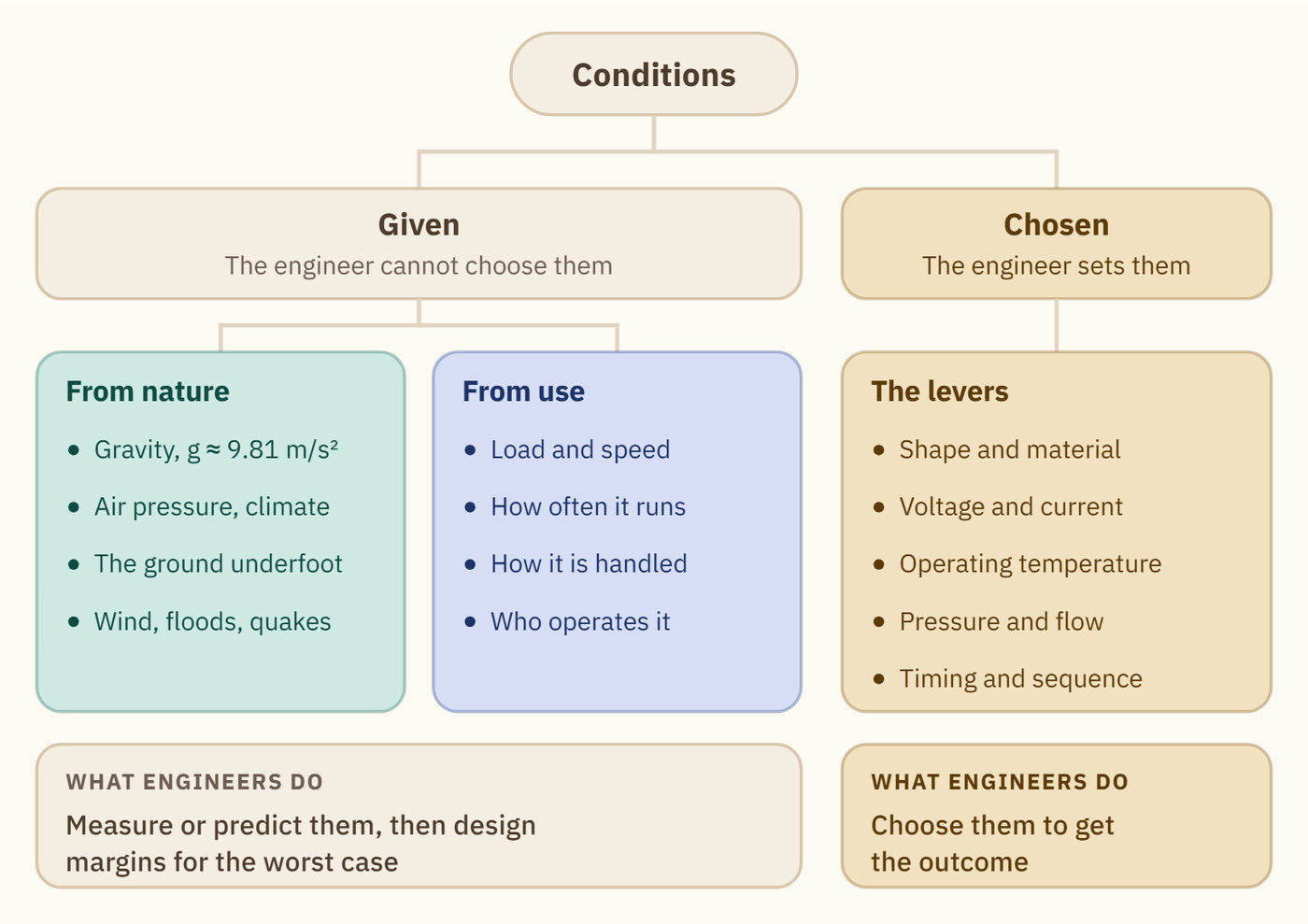
Conditions are where design lives. One question sorts them: can the engineer choose it? Some conditions are given. Nature sets gravity, the climate and the ground underfoot; the people who use a design set its load, how often it runs and how it is handled. Engineers cannot choose these, so they measure or predict them and design margins for the worst case. The rest are chosen: shape, material, voltage, operating temperature, pressure and timing. These are the engineer's levers. Change the conditions you can choose, and the same property yields a different outcome.
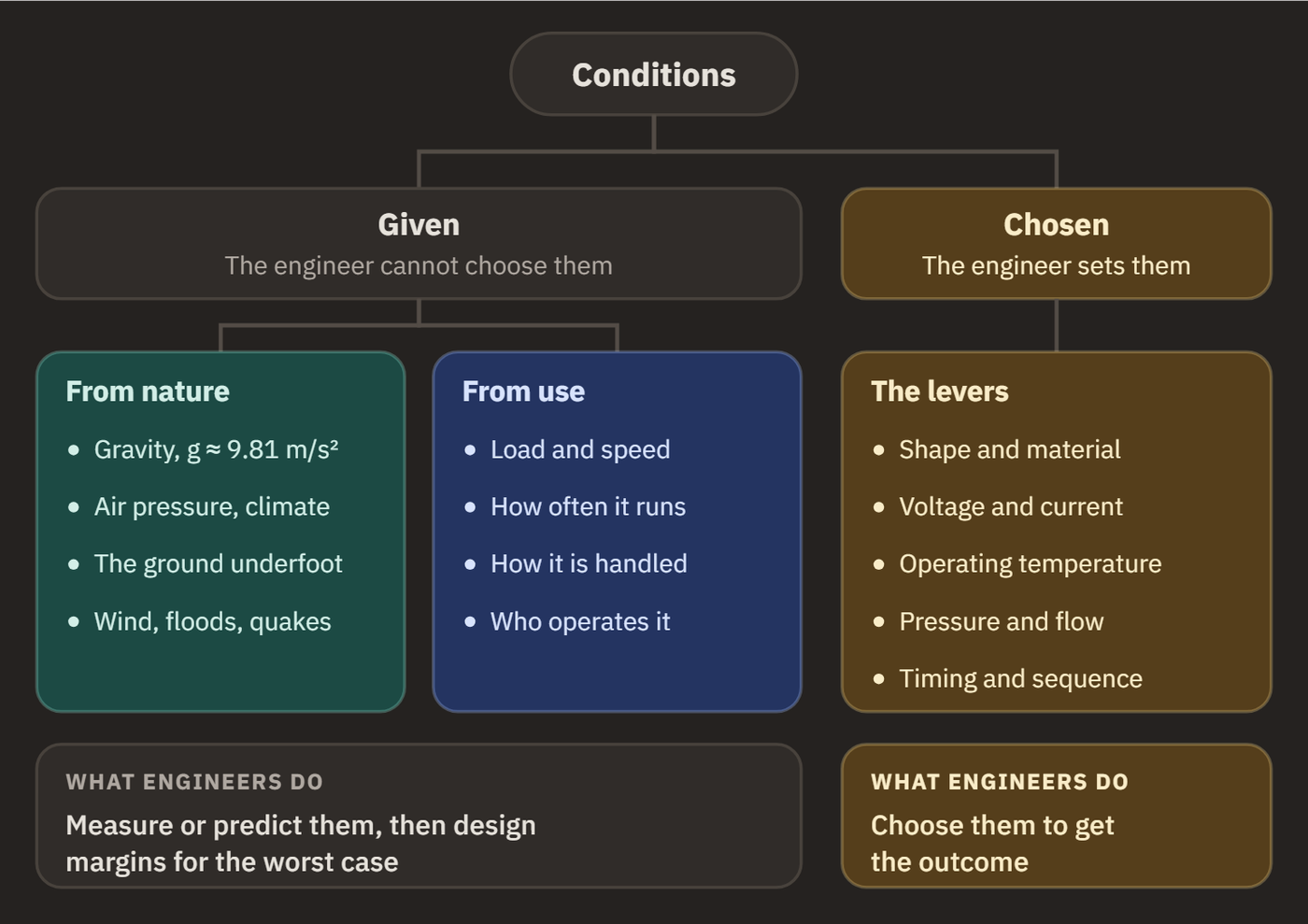
Energy and resources are the budget. Every outcome costs physical energy, such as fuel and electricity, and resources: money, materials and human effort. Both are finite. No engineer can enlarge them at will, so the craft lies in spending them well: cutting waste, choosing cheaper sources, storing energy for later and directing it where it counts.
Time can be spent, sequenced and synchronized, but never reversed. It is what turns the other three into a process. The rate at which energy is delivered is power. A part loaded again and again, year after year, reveals fatigue, corrosion and wear. Conditions held over time become a system.
Strip any engineered thing down far enough and you find the same four moves: choosing properties, setting conditions, budgeting energy and resources, and governing time.
Once you see the world as properties under conditions, four things shift.
You define the outcome; you design the conditions that produce it. You cannot command a bridge to stand, a circuit to switch or a product to succeed. You can only create the conditions in which each becomes likely.
Every system has a limited energy supply. No device can create energy; it can only convert what it is given, and every real conversion wastes some as heat. So every design is a budget: how much useful outcome per unit of energy? Battery life, fuel cost and efficiency are all the same question.
Constraints become inputs. Material strength, money, time and safety are not walls around the problem. They are variables inside the function.
It scales to any level. The same thinking builds a water tank for a village, a power grid for a state, a rail network for a nation, and an undersea internet cable between continents. The laws never change. But scale changes which effects matter most, so a design that works small cannot simply be enlarged.
Properties, laws and principles: the difference in one minute
A property is what a thing is like. A law is how properties reliably relate, within a known range. In this series, a principle is how engineers put that relationship to work.
| Term | What it means | Example |
|---|---|---|
| Property | A measurable trait of a material or system | Conductivity, density, stiffness (Young's modulus) |
| Law | A concise, often mathematical statement of a regularity in nature, confirmed by repeated experiment and valid throughout its domain; it describes what happens, not why | Ohm's law (V = IR), Newton's second law (F = ma), conservation of energy |
| Principle | In this series: a law put to work as a design tool (physics often uses 'law' and 'principle' interchangeably) | Pascal's principle in hydraulic brakes, Archimedes' principle in ship hulls |
| Theory | An explanation of why the laws hold | Maxwell's electromagnetic theory |
| Model | A simplified picture used to predict results | A beam model, a circuit model of ideal resistors and capacitors |
In short: laws tell you what happens; principles tell you how to use it. OpenStax (opens in a new tab)openstax.orgCollege Physics 2eEvery example in this table has a page you can check: Ohm's law §20.2, Newton's second law §4.3, Pascal §11.5, Archimedes §11.7. Maxwell 1865 (opens in a new tab)doi.orgA Dynamical Theory of the Electromagnetic FieldThe paper that united electricity, magnetism and light, and predicted the waves that radio, Wi-Fi and your phone use today. Each of these gets its own deep dive later in this series.
What each branch of engineering boils down to
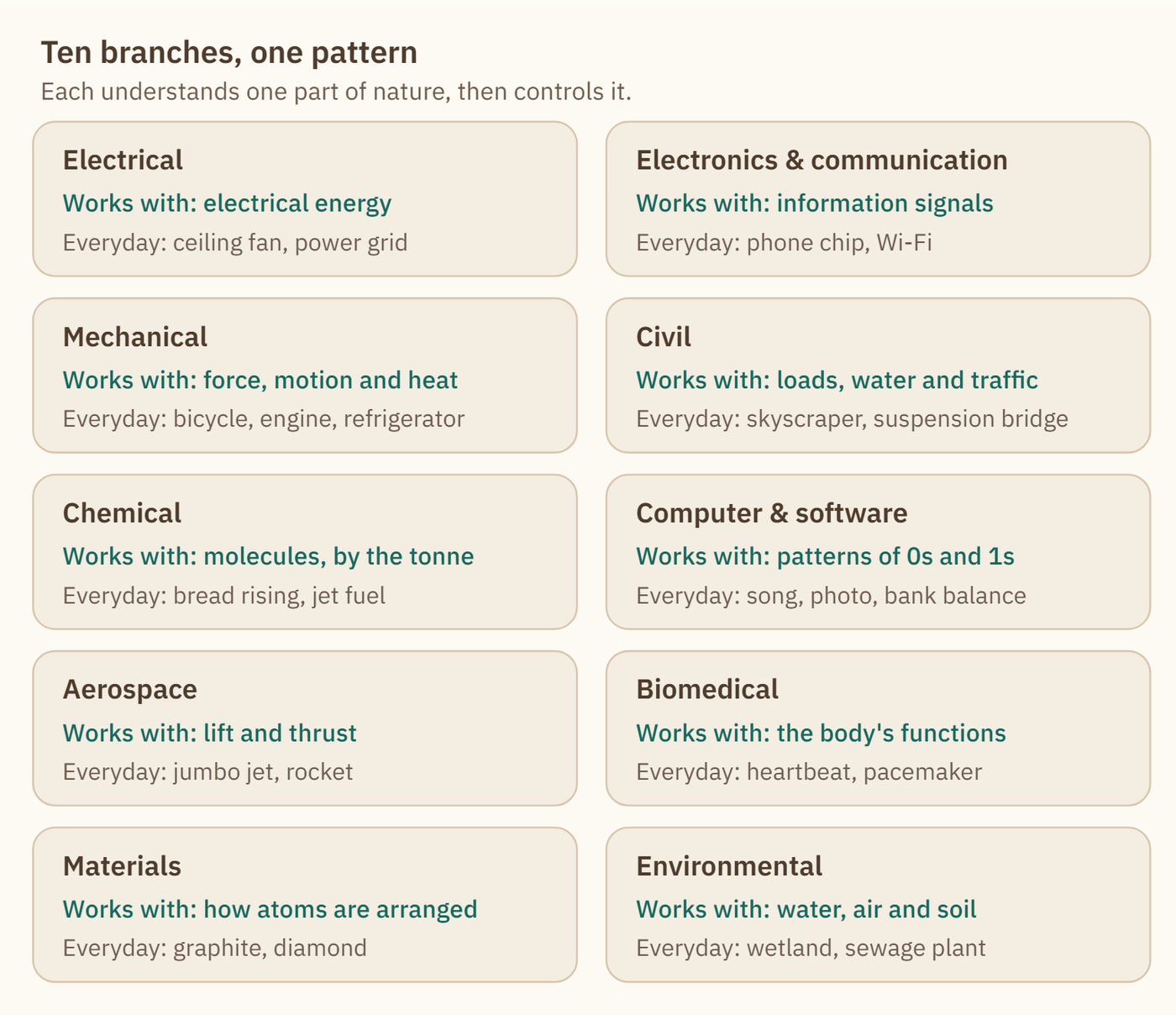
Every branch follows the same pattern: understand something in nature, then control it, within a finite budget of energy, resources and time, to produce a desired outcome.
| Branch | What it boils down to | Examples |
|---|---|---|
| Electrical | A ceiling fan and a city's power grid do one job: generate electrical energy, carry it as current, and turn it into motion, heat or light | Generators, transformers, electric motors, power grids |
| Electronics & communication | A phone's chip and its antenna share one job: control tiny currents and electromagnetic waves so they carry information. Wi-Fi, a TV remote and sunlight are the same kind of wave at different wavelengths | Transistors, radio, Wi-Fi and 5G, optical fibre |
| Mechanical | A bicycle and a car engine both manage force and motion. An engine turns part of its heat into work; a refrigerator spends work to push heat out: one principle, run in reverse | Engines, gears, refrigerators, wind turbines |
| Civil | A skyscraper presses its weight into the ground; a suspension bridge hangs it from cables. Both carry loads from gravity, wind and earthquakes safely into the earth. Civil engineers also move water and traffic through cities | Bridges, dams, high-rise buildings, highways |
| Chemical | Bread rising and jet fuel burning are both molecules rearranging. Chemical engineers make such changes happen safely, by the tonne, then separate what is wanted from what is not | Fuel refining, fertilisers, medicines, water purification |
| Computer & software | A song, a photo and a bank balance are, underneath, one thing: patterns of 0s and 1s, stored in hardware and transformed by programs | Processors, operating systems, search engines, AI models |
| Aerospace | Every flying machine works by pushing something the other way: a wing deflects air downward for lift, and a rocket throws its exhaust backward for thrust | Aircraft wings, jet engines, rockets, satellites |
| Biomedical | Biomedical engineers measure, support or replace the body's functions. A heartbeat is triggered by an electrical signal; a pacemaker supplies it when the heart's own is too slow or blocked | Pacemakers, MRI scanners, prosthetic limbs, dialysis machines |
| Materials | Graphite, as in pencil lead, and diamond are both pure carbon; rearrange the atoms and you redesign the material | Alloys, semiconductors, composites, ceramics |
| Environmental | A sewage plant does what wetlands have always done, letting microbes break down waste, only faster. Environmental engineers protect water, air and soil from what cities and industry release | Sewage treatment, air filters, landfill design |
Different names, one idea: understand nature, then control it within a defined budget of energy, resources and time.
Why your first instinct about trends is often wrong
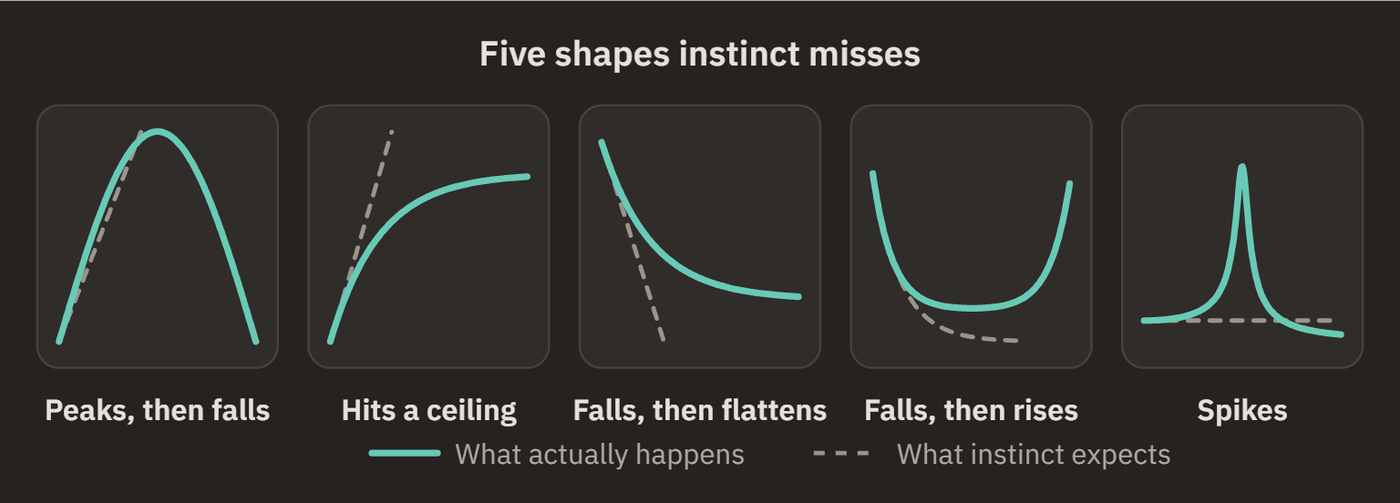
When we see a trend, the brain's first move is efficient and quietly dangerous: it notes the direction and assumes the line will continue. Rising means it will keep rising. Falling means it will keep falling.
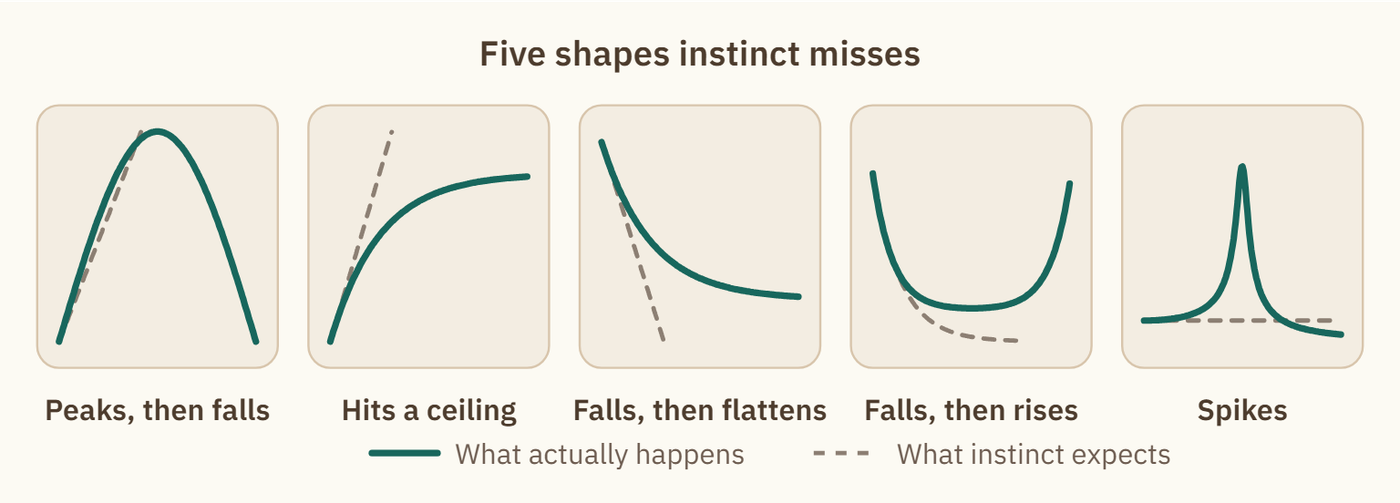
Nature rarely draws straight lines. Here are five everyday stories. In each one, instinct draws a straight line, and the world draws a curve.
Light a bulb: more current is not more power
Connect a bulb to a battery and current flows. Swap in bulbs that draw more and more current, and instinct says the bulb gets ever more power: double the current, double the power.
It does not. Every battery has a small resistance of its own, and the same current heats it too. The power reaching the bulb rises, peaks when the bulb's resistance equals the battery's own, then falls, until at a short circuit the bulb gets nothing and the battery gets all of it as heat. At that peak the bulb receives the most power the battery can give, but only at 50% efficiency: the other half heats the battery itself. IIT (ISM) notes (opens in a new tab)people.iitism.ac.inMaximum power transfer theoremAt maximum power transfer the efficiency is 50%: half the power generated is dissipated in the internal resistance. OpenStax UP2 §10.1 (opens in a new tab)openstax.orgUniversity Physics Volume 2: Electromotive ForceA load draws the most power from a source when its resistance equals the source's internal resistance. Radio engineers match an antenna to its receiver for exactly this reason. Power companies do the opposite: they keep their own resistance far below the load's, because for them efficiency matters more than the peak.
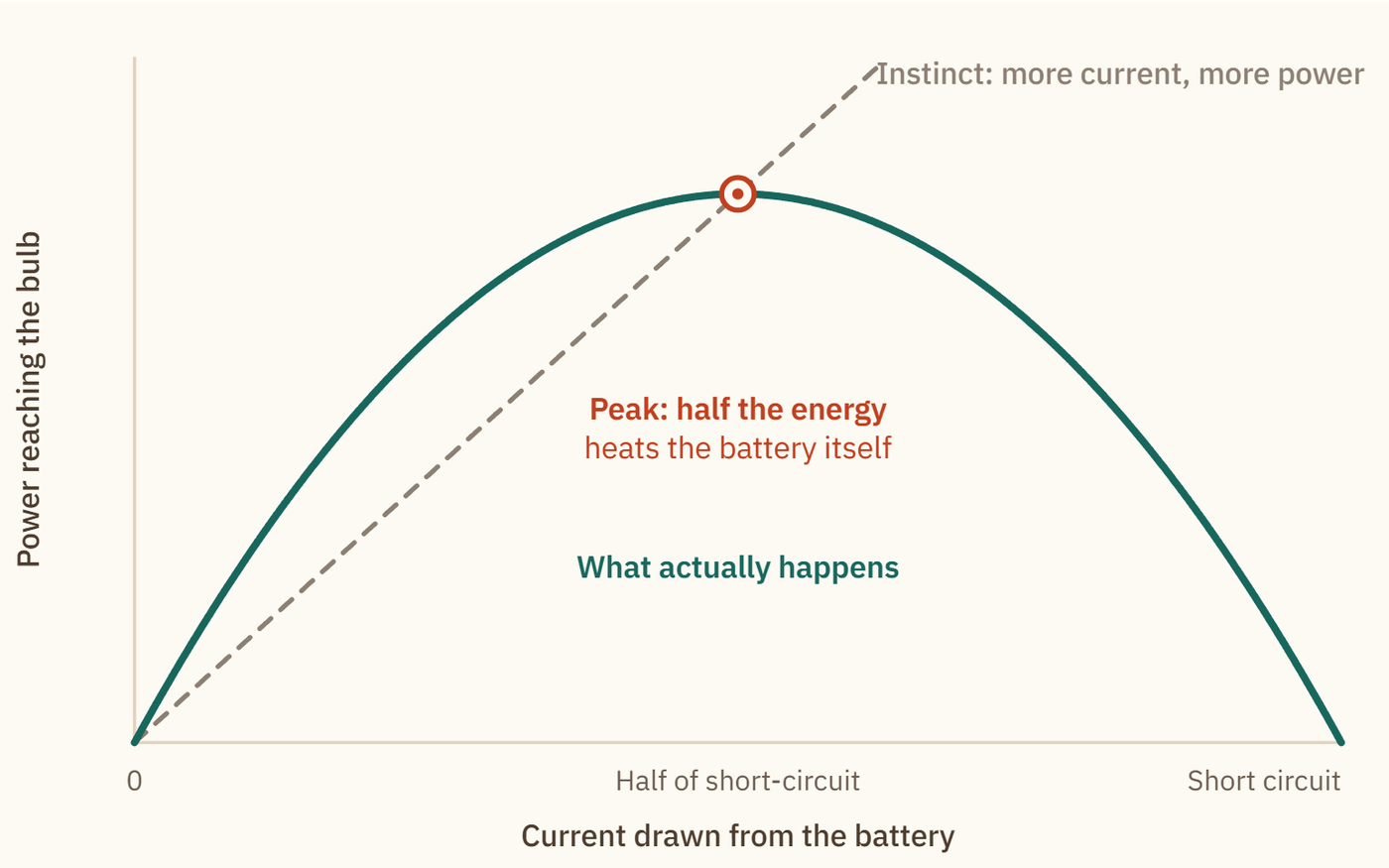
A rising trend can peak, then fall. More helps only up to a point.
Watch the rain: a ceiling that falls from the sky
Rain falls from clouds a kilometre or two up. NWS (opens in a new tab)weather.govCloud ClassificationLow clouds, the ones that bring most rain, have their bases below about 2 km (6,500 feet). With no air in the way, a drop falling 2 km would land at about 198 m/s, over 700 km/h.
Air pushes back harder the faster a drop falls: drag grows with the square of speed. Within about two seconds a large drop reaches the speed at which drag balances its weight, about 9 m/s or 33 km/h, and from then on it never falls faster. Gunn & Kinzer 1949 (opens in a new tab)journals.ametsoc.orgThe terminal velocity of fall for water droplets in stagnant airA 5 mm drop falls at about 9.1 m/s in still air; the largest stable drops, about 5.8 mm, at about 9.2 m/s. Engineers call this terminal velocity, and every parachute and spray nozzle is designed around it.
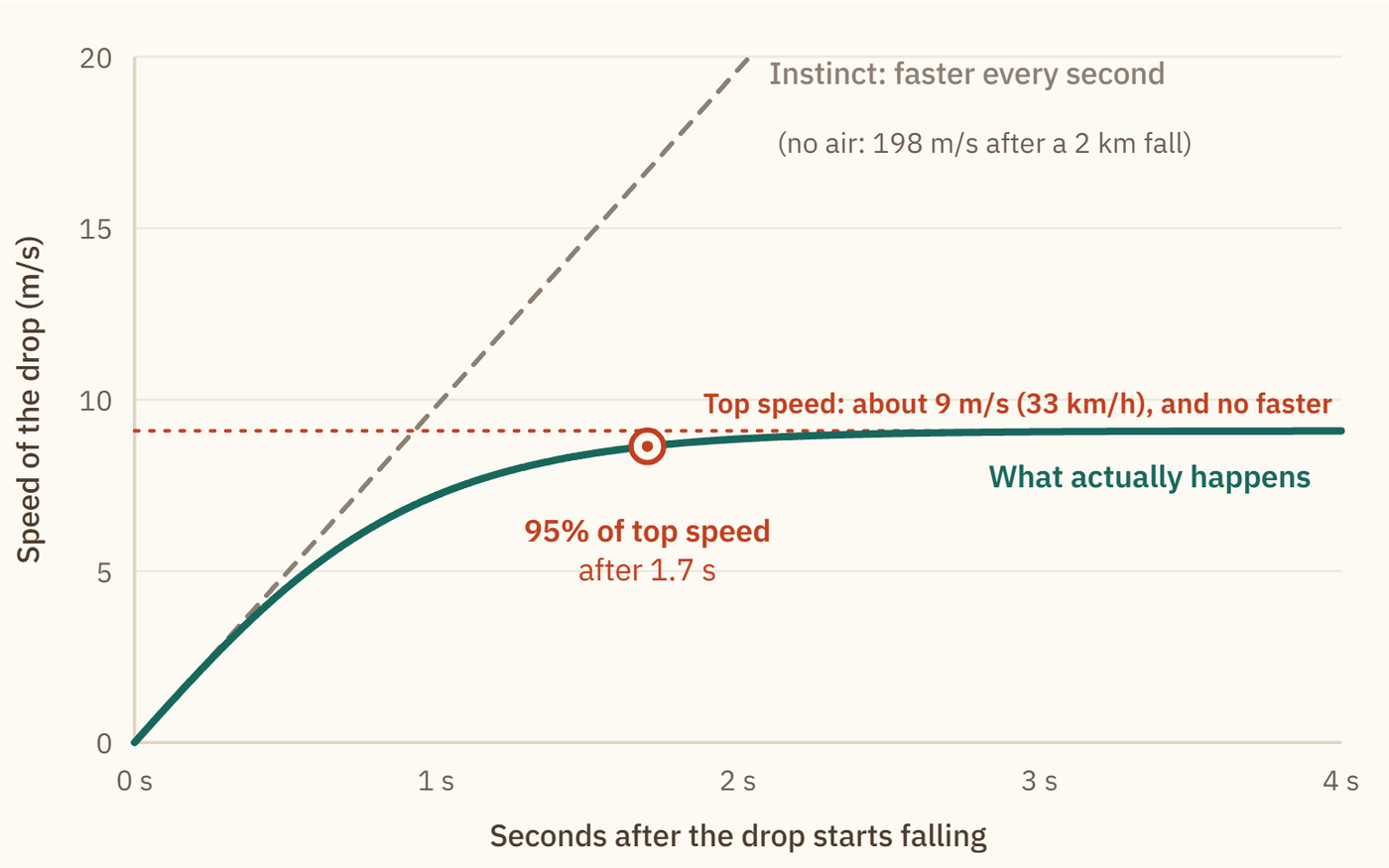
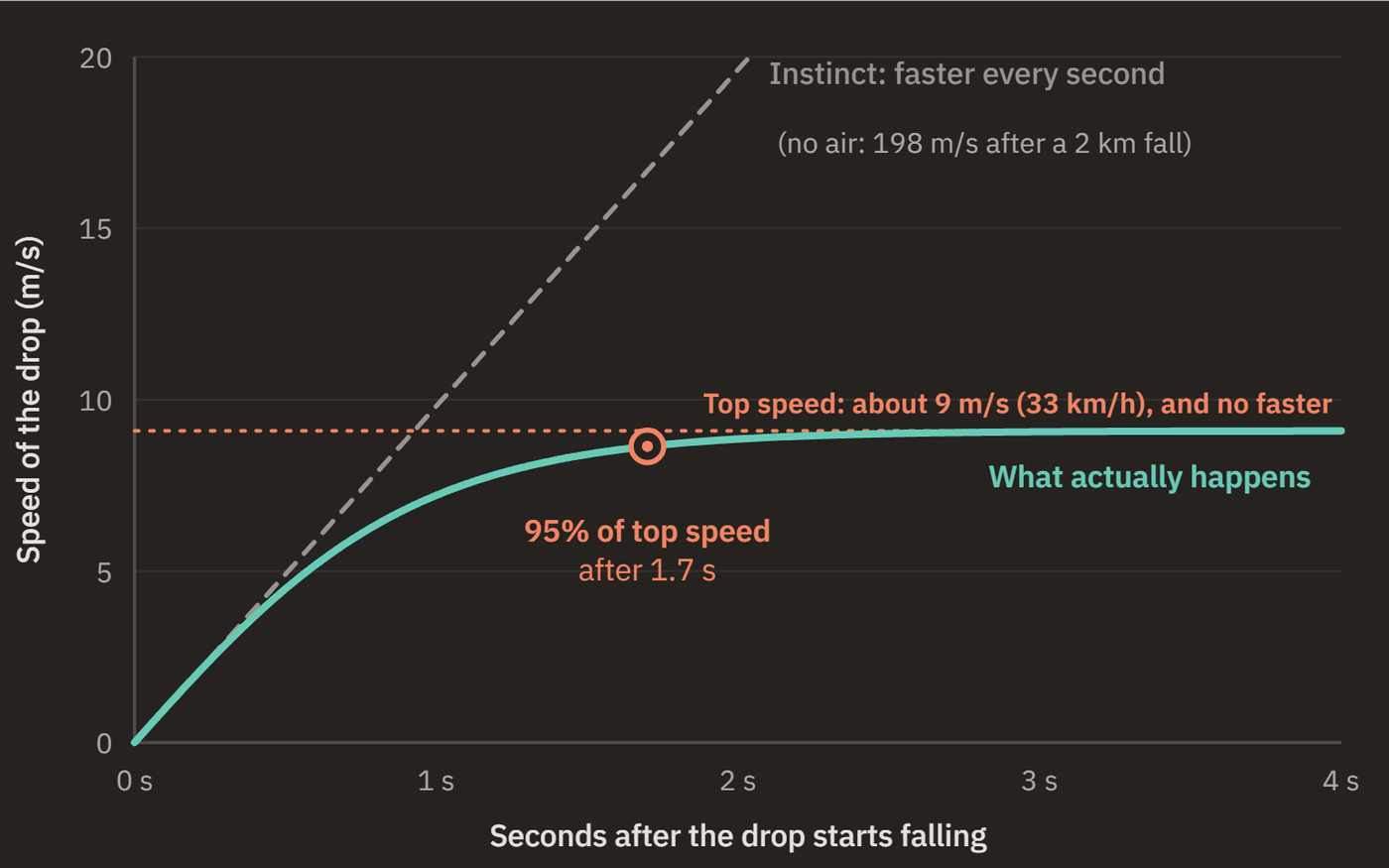
A rising trend can level off beneath a ceiling it will never cross.
Count the caffeine: why the evening chai is still with you at midnight
Drink a cup of chai at 5 pm. Instinct says its caffeine wears off in a few hours, gone well before morning.
It does not. The body clears caffeine at a rate proportional to how much is left, so the amount halves over a fixed time, its half-life: about 5 hours in a typical healthy adult, though anywhere from 1.5 to 9.5 hours from person to person. IOM 2001 (opens in a new tab)ncbi.nlm.nih.govCaffeine for the Sustainment of Mental Task Performance, ch. 2The mean half-life of caffeine in healthy adults is about 5 hours, ranging from 1.5 to 9.5 hours. At 10 pm about half of that chai's caffeine is still in your body; at 3 am, about a quarter. A cup of tea carries about 30 to 65 mg. ICMR-NIN 2024 (opens in a new tab)nin.res.inDietary Guidelines for IndiansA 150 mL cup of tea has about 30 to 65 mg of caffeine, against 80 to 120 mg for brewed coffee. The same halving curve describes a capacitor draining through a resistor, and the radioactive decay that carbon dating relies on.
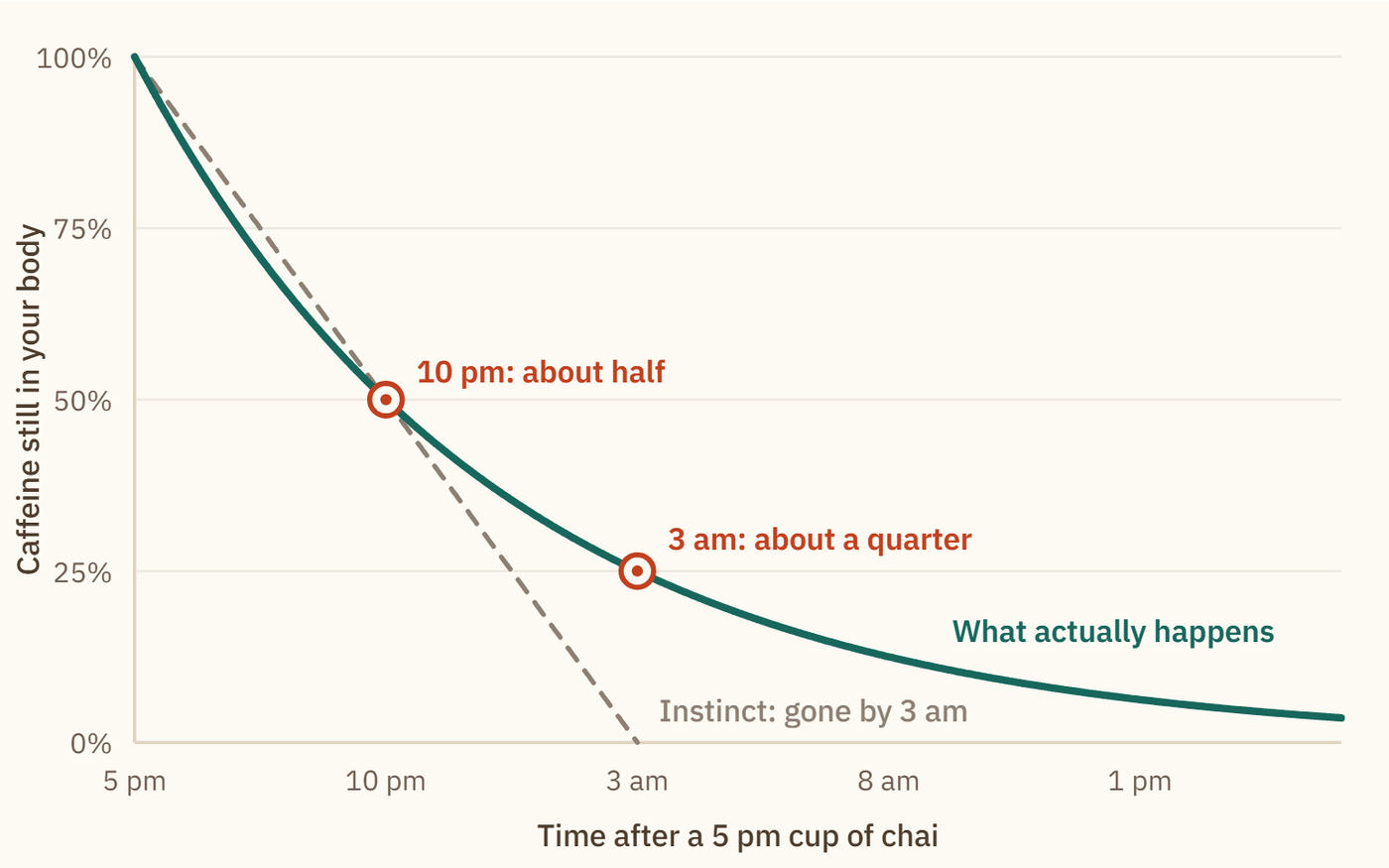
A falling trend can flatten instead of falling to zero.
Drive across town: slower is not always cheaper
Stuck in traffic, instinct says driving slowly at least saves fuel: the slower the car, the less it burns.
Per kilometre, the slow end turns the other way. An engine burns fuel just to keep running, so at low speed that fuel is spread over very few kilometres. Speed up and fuel per kilometre falls, bottoms out at roughly 55 to 90 km/h, then climbs again as air drag grows with the square of speed. In steady-speed tests reported by Oak Ridge National Laboratory, 1990s cars used about 30% more fuel per kilometre at 24 km/h than at 70. US DOE (opens in a new tab)fueleconomy.govDriving More EfficientlyGas mileage usually decreases rapidly at speeds above 50 mph (80 km/h). ORNL TEDB 40 (opens in a new tab)afdc.energy.govTransportation Energy Data Book, ed. 40, Table 4.34Fuel economy by speed: the 1997 study of nine cars peaked between about 80 and 89 km/h and fell away at both ends.
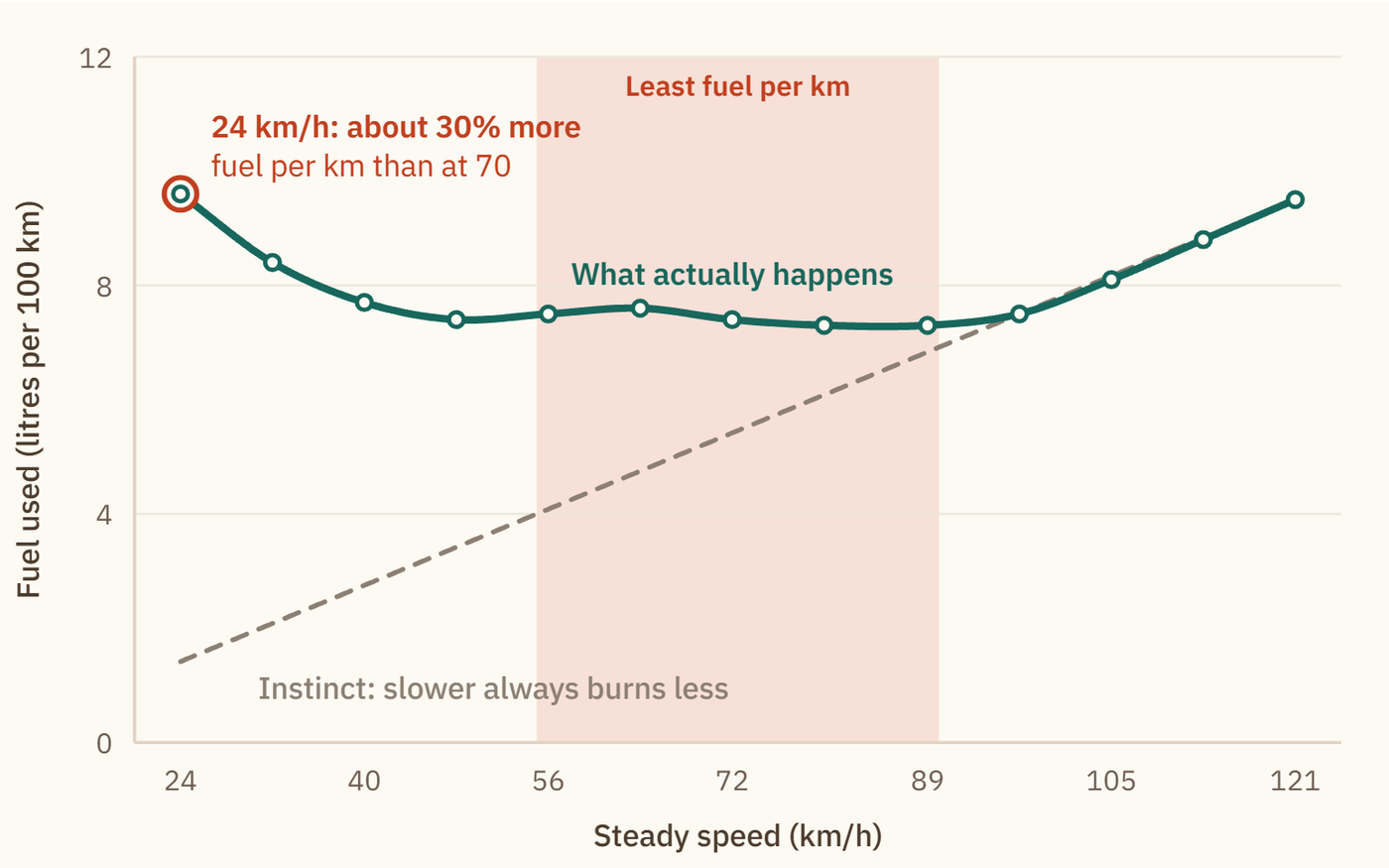
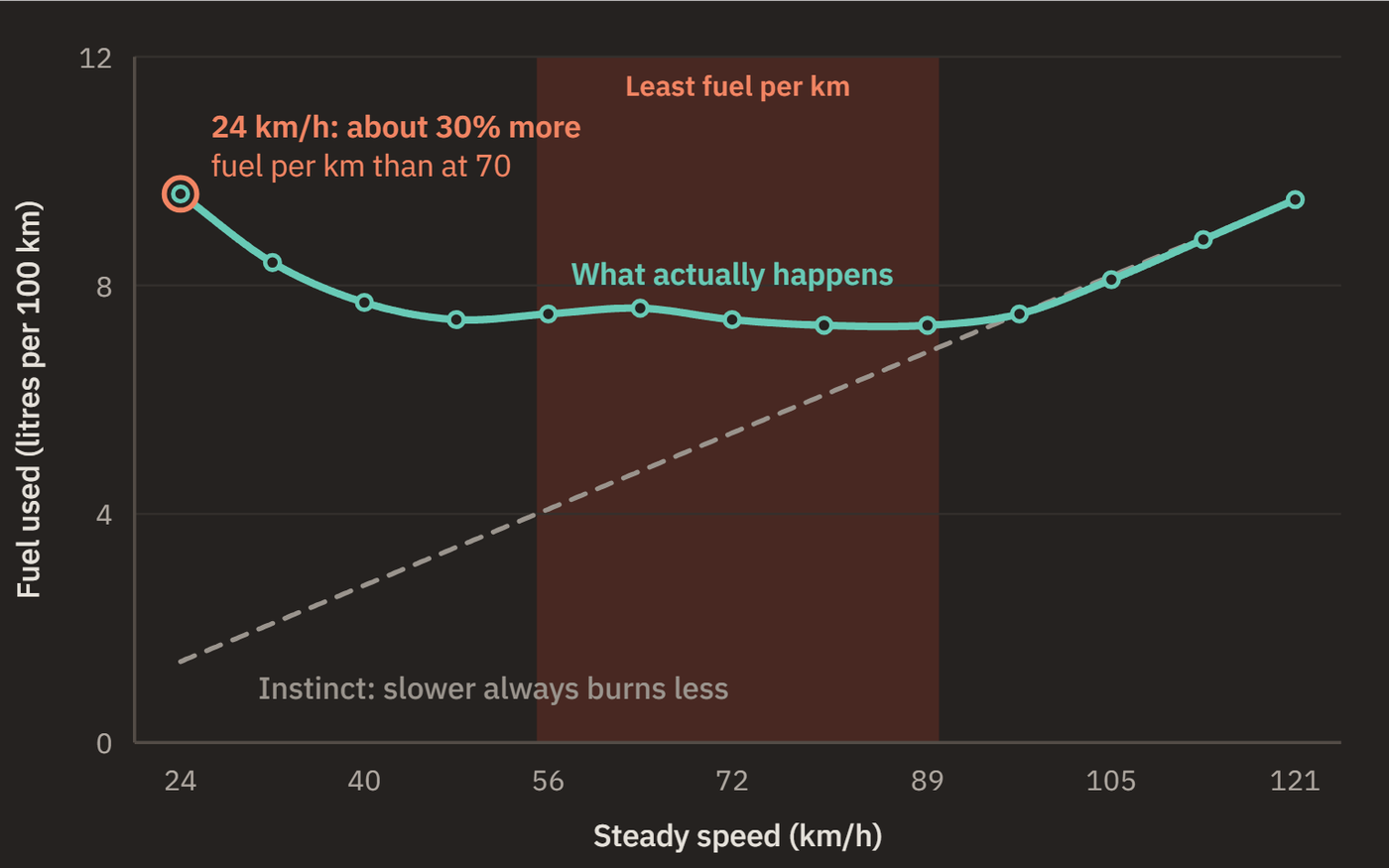
A falling trend can level off, then rise again.
Sing to a glass: timing beats strength
Instinct says breaking a glass takes force: the harder you push, the more it shakes. A voice, however loud, should do nothing.
Yet every glass has a natural frequency, the note it rings at when you tap it. OpenStax §16.8 (opens in a new tab)openstax.orgCollege Physics 2e: Forced Oscillations and ResonanceDriving a system at its natural frequency makes each push add to the motion, so the amplitude grows. Sing exactly that note and each wave of sound pushes the glass just as it swings back, so the vibration builds cycle after cycle. In 2005 the singer Jaime Vendera broke a crystal wine glass this way with his unamplified voice, holding the note at about 105 decibels; it took twelve glasses before one shattered. Scientific American (opens in a new tab)scientificamerican.comFact or fiction?: An opera singer's piercing voice can shatter glassIt works only with thin crystal, a sustained note at the glass's own frequency, and more than 100 decibels.
Bridges face a cousin of this effect. London's Millennium Bridge began swaying sideways the day it opened in June 2000: as the deck moved, walkers adjusted their steps to keep their balance and pushed it further, and it closed two days later until dampers were fitted. Dallard et al. 2001 (opens in a new tab)istructe.orgThe London Millennium FootbridgeEngineers named it synchronous lateral excitation: a feedback between the swaying deck and the walkers' steps.
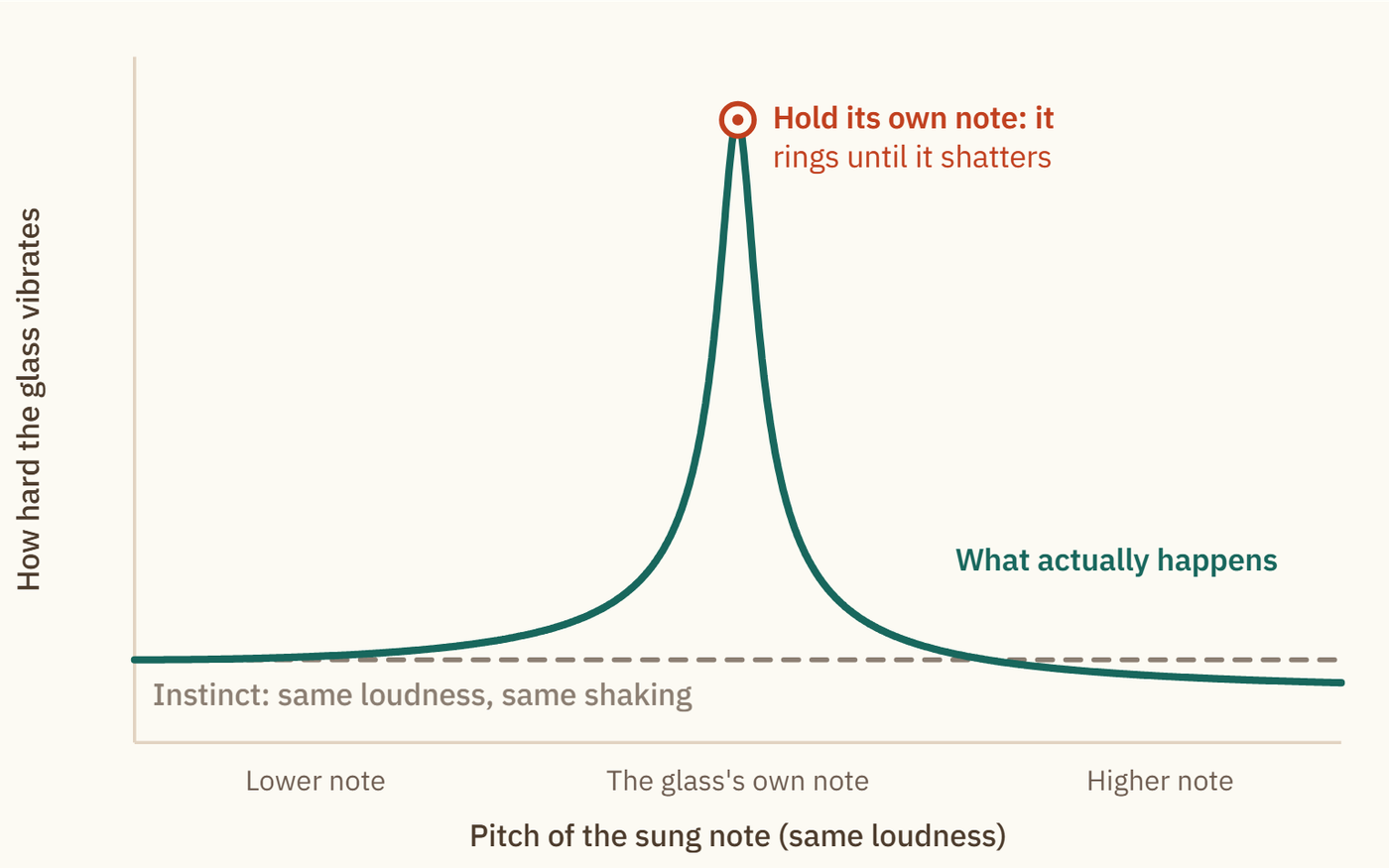
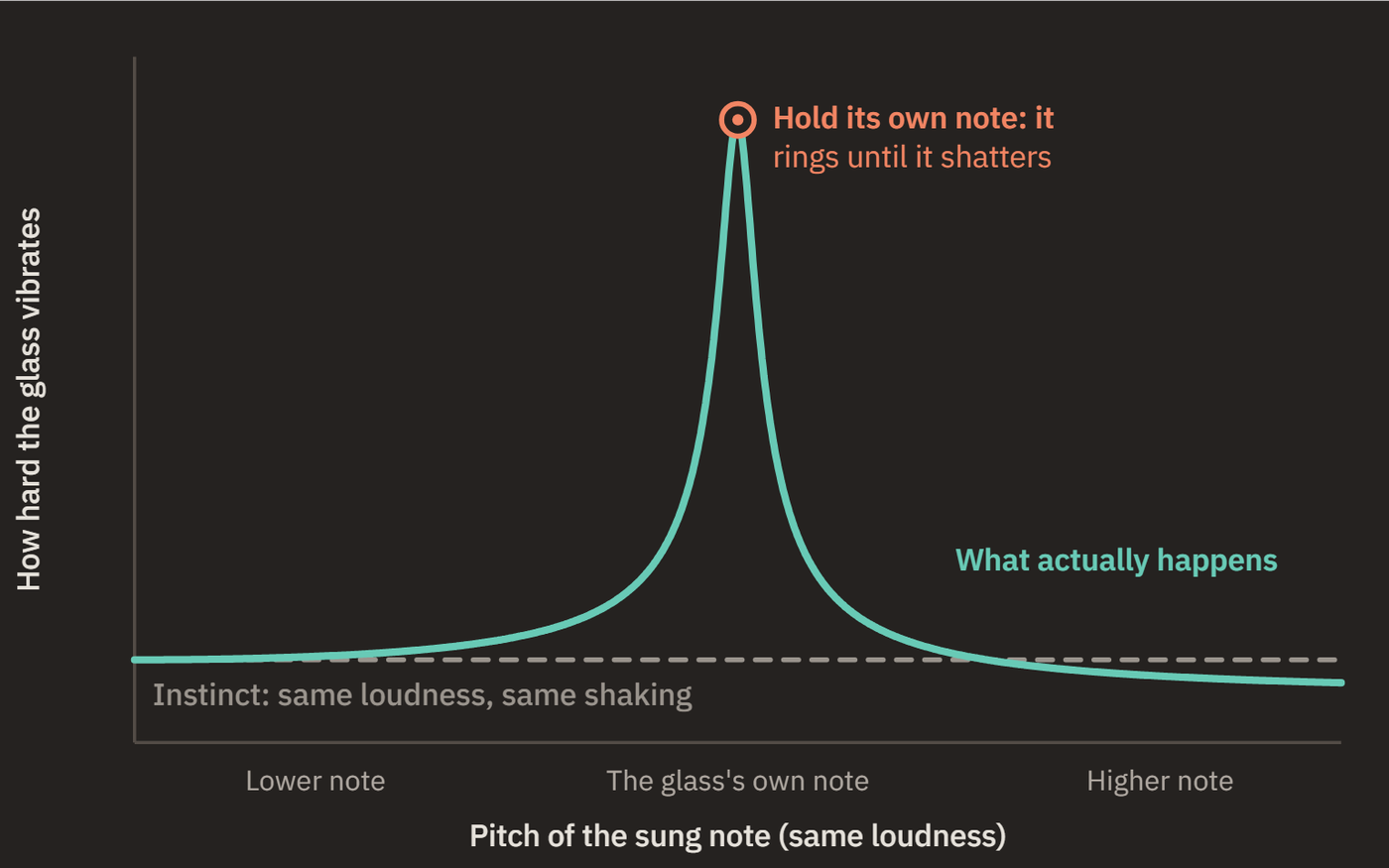
Sometimes the curve does not bend at all; it spikes. What matters is not how hard you push, but when.
Where instinct breaks, branch by branch
The same shapes turn up in every branch of engineering.
| Branch | What instinct says | What actually happens |
|---|---|---|
| Electrical | Send power at a higher voltage, and losses keep falling | The savings shrink: at very high voltages the electric field ionises the air around the wire (corona discharge), which crackles and wastes power, and towers and insulators cost more |
| Electronics & communication | A faster clock always means a faster chip | Power, and so heat, climbs steeply with clock speed, because faster clocks need higher voltage, so since the mid-2000s chips add cores instead |
| Mechanical | Rev an engine harder for more power | Power peaks at a certain engine speed, then falls |
| Civil | Scale a design up and it stays just as strong | Weight grows with the cube of size but strength only with the square, so more of the strength goes into holding up its own weight |
| Chemical | A hotter reaction always gives more ammonia | Heat speeds the reaction but shrinks the share of gas that ends up as ammonia, so plants settle near 450 °C, with an iron catalyst and high pressure |
| Computer & software | More processors, proportionally faster programs | The part of a job that cannot be split across processors caps the speed-up (Amdahl's law) |
| Aerospace | Tilt the wing more for more lift | Past the critical angle of attack, air stops following the wing's upper surface and lift drops sharply: a stall |
| Biomedical | A bigger dose, a stronger cure | The benefit levels off while side effects keep rising |
| Materials | Harder steel is always better steel | Very hard steel turns brittle: it shatters instead of bending |
| Environmental | More fertiliser, bigger harvests | Yields level off, and the extra washes into rivers, feeding algae whose decay strips the water of oxygen |
Sources for this table: Sutter 2005 (opens in a new tab)gotw.caThe Free Lunch Is OverBy the mid-2000s, heat, power and leakage stopped clock speeds rising, so chipmakers turned to multiple cores. US EPA (opens in a new tab)epa.govBasic Information on Nutrient PollutionToo much nitrogen and phosphorus makes algae grow faster than rivers and lakes can handle. Galileo 1638Dialogues Concerning Two New SciencesGalileo explained why there are no giants: scale a body up and its bones grow weaker relative to its weight. Amdahl 1967 (opens in a new tab)doi.orgValidity of the single processor approach to achieving large scale computing capabilitiesIf a fraction s of the work cannot be shared, speed-up can never pass 1/s, however many processors are added. RSC (opens in a new tab)edu.rsc.orgAmmoniaAmmonia plants run near 450 °C and 200 atmospheres: hot enough to be fast, cool enough to keep the yield. FAA 2023 (opens in a new tab)faa.govPilot's Handbook of Aeronautical Knowledge, ch. 5A stall comes from exceeding the critical angle of attack, not simply from flying too slowly. StatPearls (opens in a new tab)ncbi.nlm.nih.govED50The therapeutic index compares the dose that helps half of patients with the dose that harms half.
Read these together and one lesson stands out: a trend is a direction, not a destiny. The engineer's question is never only "which way is it moving?" but "where does the curve bend?"
Frequently asked questions
What is engineering in simple words?
Engineering is using what we know about nature to make things that work. Engineers start from the outcome they want, then choose materials and arrange conditions such as shape, temperature or voltage so that nature delivers it, within a budget of energy, resources and time.
What does an engineer actually do?
An engineer starts from an outcome, not a tool. First comes the need: what must work, for whom, how well and by when. Then three lists: what cannot change (the laws of nature), what is fixed for this job (budget, time, materials, safety rules), and what is free to choose. From there the engineer reasons backwards: which arrangement of materials and conditions, obeying those laws, delivers the outcome within those limits? Calculations, models and prototypes test each answer before anything is built at scale.
What is the difference between science and engineering?
Science asks why nature behaves as it does. Scientists observe and experiment, state the regularities they find as laws, and explain them with theories. Engineering starts from a need and uses those laws to make something that works within limits of cost, safety and time. A physicist explains why a steel beam bends under load; an engineer decides how deep the beam must be so that it never bends too far.
What is the difference between engineering and technology?
Engineering is the work of designing a solution from scientific principles. Technology is what that work produces and how it is used: the tools, machines and systems people run every day. Engineers design an electric motor; technicians and technologists install, operate and maintain the machines built around it.
What are the main branches of engineering?
The main branches are electrical, electronics and communication, mechanical, civil, chemical, computer and software, aerospace, biomedical, materials and environmental engineering. Each understands one part of nature and controls it, within a defined budget of energy, resources and time, to produce a desired outcome.
How do I choose an engineering branch?
Treat it as an engineering decision: define the outcome, list the constraints, compare the options. The outcome is the kind of problem you want to work on every day: circuits, machines, structures, chemical plants or software. The constraints are the subjects each branch leans on (electrical: circuits and electromagnetics; mechanical: mechanics and thermodynamics; civil: structures and soils; computer science: algorithms and discrete maths), the colleges your rank opens, and where graduates work: core industry, research or software. Many students also weigh college against branch: a branch they love at one college, or a stronger college with a branch they like less. Lasting interest in the daily work matters more than one year's placement figures.
What is the difference between a law and a principle in physics?
A law states what nature does, reliably, within its domain: Ohm's law says the current through a metal wire at steady temperature is proportional to the potential difference across it, V = IR. A principle is a rule drawn from laws and applied in design: Pascal's principle explains how a gentle press on a brake pedal becomes a force large enough to clamp the brakes of a heavy car. OpenStax §11.5 (opens in a new tab)openstax.orgCollege Physics 2e: Pascal's PrincipleYour foot pushes a small piston; the brake fluid carries the same pressure to bigger pistons at the wheels, which multiplies the force.
Is engineering hard?
Engineering is demanding: it builds on mathematics and physics, and the first two years carry a heavy workload. It becomes far more manageable when you learn each idea from first principles, why it is true, instead of memorising formulas, because later subjects keep reusing the same few laws.
Why is engineering important?
Engineering turns knowledge of nature into the things a society runs on: clean water, electricity, food storage, medicine, transport and communication. Most of what lets a city of millions work, from the pumps that lift water to the grid that lights homes at night, exists because engineers arranged materials and energy to work reliably, at scale.
The world is already capable
The stranger on the track proved something without meaning to. Outcomes are not willed into existence. They emerge when properties meet the right conditions.
The engineer's job is not to be the hero who jumps. It is to build the fence, the signal and the refuge, so no one has to.
So the next time you switch on a light, cross a bridge or send a message, ask one question: which property is working for me right now, and who arranged the conditions?
Coming next in this series: the laws of engineering, explained one at a time, then the principles each branch is built on. Follow along, and share this with someone who is choosing a branch of engineering.
The figures in this essay are by Inquinion and free to reuse under CC BY 4.0, with credit to Inquinion and a link to this page.
References
- Amdahl, G.M. (1967) 'Validity of the single processor approach to achieving large scale computing capabilities', AFIPS Spring Joint Computer Conference, pp. 483–485. doi.org ↗ (opens in a new tab)
- Azevedo, F.A.C. et al. (2009) 'Equal numbers of neuronal and nonneuronal cells make the human brain an isometrically scaled-up primate brain', Journal of Comparative Neurology, 513(5), pp. 532–541. doi.org ↗ (opens in a new tab)
- CERN (n.d.) The Standard Model. home.cern ↗ (opens in a new tab)
- Dallard, P. et al. (2001) 'The London Millennium Footbridge', The Structural Engineer, 79(22), pp. 17–33. istructe.org ↗ (opens in a new tab)
- Davis, S.C. and Boundy, R.G. (2022) Transportation Energy Data Book: Edition 40, Table 4.34. Oak Ridge, TN: Oak Ridge National Laboratory. afdc.energy.gov ↗ (opens in a new tab)
- Federal Aviation Administration (2023) Pilot's Handbook of Aeronautical Knowledge (FAA-H-8083-25C), ch. 5: Aerodynamics of Flight. faa.gov ↗ (opens in a new tab)
- Galilei, G. (1914 [1638]) Dialogues Concerning Two New Sciences. Translated by H. Crew and A. de Salvio. New York: Macmillan.
- Gunn, R. and Kinzer, G.D. (1949) 'The terminal velocity of fall for water droplets in stagnant air', Journal of Meteorology, 6(4), pp. 243–248. journals.ametsoc.org ↗ (opens in a new tab)
- ICMR–National Institute of Nutrition (2024) Dietary Guidelines for Indians. Hyderabad: ICMR-NIN. nin.res.in ↗ (opens in a new tab)
- Institute of Medicine (US) Committee on Military Nutrition Research (2001) Caffeine for the Sustainment of Mental Task Performance, ch. 2 'Pharmacology of Caffeine'. Washington, DC: National Academies Press. ncbi.nlm.nih.gov ↗ (opens in a new tab)
- Institution of Civil Engineers (n.d.) ICE Archives (holds Tredgold's 1828 definition for the Royal Charter). ice.org.uk ↗ (opens in a new tab)
- Ling, S.J., Moebs, W. and Sanny, J. (2016) University Physics Volume 2, ch. 10. Houston: OpenStax. openstax.org ↗ (opens in a new tab)
- Maxwell, J.C. (1865) 'A dynamical theory of the electromagnetic field', Philosophical Transactions of the Royal Society of London, 155, pp. 459–512. doi.org ↗ (opens in a new tab)
- National Weather Service (n.d.) Cloud Classification. NOAA. weather.gov ↗ (opens in a new tab)
- Royal Society of Chemistry (n.d.) Ammonia. RSC Education. edu.rsc.org ↗ (opens in a new tab)
- Sarun, P.M. (2025) 'Maximum power transfer theorem', NPHC206 Electronics class notes, IIT (ISM) Dhanbad. people.iitism.ac.in ↗ (opens in a new tab)
- Schrock, K. (2007) 'Fact or fiction?: An opera singer's piercing voice can shatter glass', Scientific American, 23 August. scientificamerican.com ↗ (opens in a new tab)
- StatPearls (2024) ED50. Treasure Island, FL: StatPearls Publishing. ncbi.nlm.nih.gov ↗ (opens in a new tab)
- Strogatz, S.H. et al. (2005) 'Crowd synchrony on the Millennium Bridge', Nature, 438, pp. 43–44. doi.org ↗ (opens in a new tab)
- Sutter, H. (2005) 'The free lunch is over: a fundamental turn toward concurrency in software', Dr. Dobb's Journal, 30(3). gotw.ca ↗ (opens in a new tab)
- United Nations (2024) World Population Prospects 2024: Summary of Results. New York: UN DESA. population.un.org ↗ (opens in a new tab)
- Urone, P.P. and Hinrichs, R. (2022) College Physics 2e. Houston: OpenStax. §4.3, §7.6, §11.5, §11.7, §15.3, §16.8, §20.2. openstax.org ↗ (opens in a new tab)
- US Department of Energy (n.d.) Where the Energy Goes: Gasoline Vehicles. fueleconomy.gov. fueleconomy.gov ↗ (opens in a new tab)
- US Department of Energy and US EPA (n.d.) Driving More Efficiently. fueleconomy.gov. fueleconomy.gov ↗ (opens in a new tab)
- US Environmental Protection Agency (n.d.) Basic Information on Nutrient Pollution. epa.gov ↗ (opens in a new tab)
Try it on your coursework
Use this on your next problem.
Bring a question from your course. Inquinion starts from what you already know and teaches the next step from your own course material.
See how the coach works
About the author
Sharath Jonnala is the Founder & CEO of Inquinion Labs. He enjoys exploring product ideas, understanding how technology works and building solutions to meaningful problems. He believes everything has something to explain and something to offer, and that even a small understanding can help make tomorrow better than yesterday. His interests span engineering, AI, product development and psychology.